



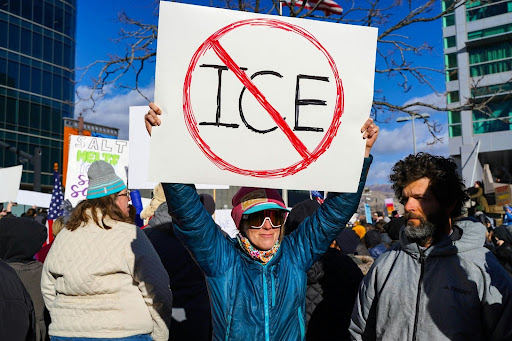






























On Saturday, Feb 21, 2026, North Central Wisconsin Indivisible held an open rally in the heart of Wausau to protest ICE, (U.S. Immigration and Customs Enforcement), bracing low twenty degree weather and harsh late winter winds. I attended this protest to hear directly from protesters about what issues they have with the agency. I fear too often we lump protesters into single belief and move on without heed to the pluralistic ambiguity that comes with politics. I aim to correct this mistake, and give voice to the people who steadfastly wave flags and signs.
Throughout my two hour time with the protesters, I had the opportunity to talk to the young and the old, the big and the small voices, the enraged and the calm, all of whom gave me deep insight into just what people truly want from these events.
What actually brings these protesters to the streets?
To start, we need to understand the organizers and what they strive to achieve. During my time in Wausau I had met with Chris Hornung, the leader of the North Central Wisconsin Indivisible group, who had this to say:
“Really, what we’re holding a protest for is a number of things, giving people the opportunity to come out and protest, and we’re letting the community know we’re concerned about things and that we’re concerned enough to come out here. And beyond getting people out and rallying, we can get these petitions signed to get a more democratic and representative government and hold politicians accountable.”
This statement of accountability for politicians and ICE officials is widely echoed by other organizers: “…organizers are calling for justice for the people detained by ICE and those killed at the hands of ICE or while in ICE custody,” says Fabiola Cineas from The Guardian.
The murder of American civilians appeared multiple times during the course of my interviews as a cornerstone of worry. Wanda, a local elderly woman said,
“Those killed in Minneapolis? That guy was shot in the head for protecting a woman they threw to the ground. They say he kicked a car, which you obviously can’t do. But that Renee Good? She’s like ‘Hey I’m not mad or anything!’ then he shoots her in the head.”
Another large sector of contention comes from the detention of Liam Ramos, a five-year-old leaving school, as two different interviews reported concerns about their own family being afraid of going to school. Bree, another organizer of the event I attended, reported that her child would get nervous and afraid whenever his friends would be missing from school for a day that they were taken away. And Wanda said “I have great nieces and nephews who live in Minneapolis who are afraid to go to school, they’re six and eight years old.”
What else drives people to protest ICE?
A large part reported by the people I spoke to was the lawless nature that ICE seems to exhibit.
Sandy, a local, believed “the injustices that ICE is doing, it’s illegal without due process, and we don’t want that.” She also says, “And we just want ICE to follow the law like they expect everyone else to do, we want people to be given their due process and not just snatched up with people having their cars smashed into or houses broken into and taken away.”
Mark, a man who I interviewed at the same time said, “They’re citizens, y’know, if you’re watching the TV they’re saying they’re getting the bad ones out. But it doesn’t sound like they’re getting them.”
What is the average American perspective of ICE?
“A majority of Americans say ICE’s tactics are too forceful and about half say they strongly disapprove of the way the agency is handling its job,” reports Alexander Rossell Hayes at, a senior data scientist at YouGov.
Most of the people I spoke to agreed that ICE was too forceful, especially when it came to the violence displayed by officials. One woman who I interviewed reports, “I don’t support the current tactics against citizens and immigrants alike, we’ve had tear gassings and citizens and immigrants die, I’d just like to see it improve.”
One interesting statistic Hayes reported was “More Americans support than oppose abolishing ICE (46% vs. 41%),” (YouGov), but there was a lot more ambiguity when I asked the protesters if it needed to go. Some called for the complete abolishment of ICE, while others believed it could and even should stay under reforms. I asked my interviewees if they thought ICE needed to be abolished, or if it was redeemable.
Hornung: “It’s complicated, ICE was created after 9/11, and I’m unaware of any major abuses until this most recent administration who has really weaponized and funded ICE. although if you were to ask me two years ago if I had any problems with ICE, I would’ve probably said no.”
Mark: “I think in its current state, it needs to go and restart from scratch. It hasn’t been around all that long, I think since 2003, and they reduced the amount of training that basically gave them a field bounty to catch a bunch of people.”
Anonymous Woman: “I wouldn’t say it needs to be abolished, I think immigration enforcement is important because you do have people who want to cause chaos or have criminal records who are not great, just like any other person. I wouldn’t say it needs to be abolished but I think it needs some pretty major reforms and an overhaul of their processes along with recruitment tactics. Starting from the top down with leadership and more training for their officers. I think ICE can stick around, they just need reform.”
Anonymous Woman 2: “I don’t know an awful lot, really, about how it ICE functioned before 9/11, but I do know that I think they shouldn’t be patrolling the streets, if someone is a criminal, illegal immigrant or citizen, I feel like there’s a better way of handling it.”
Nancy: “We didn’t have them before 9/11, we don’t need them now.”
All in all, the thoughts on how ICE should operate or be handled varies quite dramatically depending on who you’re talking to, but it goes to show that not every one believes the same thing as the person standing next to them.