



























































Horrific situations always tend to make people feel uneasy, unsafe even. Sometimes it can be something small like witnessing someone who is hurt, or scared. For some, the situations escalate from just being in fear. For some, they live in a real life horror situation that they can’t get out of, or feel like they can’t.
How does sextortion occur?
Sextortion has been on an uprise with the increased use of social media and the decrease of certain platform security. Sextortion is one of the fastest-growing online crimes globally, with victims often being from the US and Europe. The definition is a form of online blackmail where a perpetrator threatens to distribute a victim’s private, sexually explicit images or videos unless their demands are met.
According to the FBI, “Sextortion can start on any site, app, messaging platform, or game where people meet and communicate. In some cases, the first contact from the criminal will be a threat. The person may claim to already have a revealing picture or video of a child that will be shared if the victim does not send more pictures.”
Not one app is considered the “only app” where sexual extortion occurs. Almost all apps and messaging platforms have the same amount of risk. However, apps with the highest volume of cases are Instagram, Snapchat, and Facebook. All three apps have high reports, with Instagram being the highest with over 800 weekly reported cases. The similarities however consist of the material obtained and goals by the perpetrators.
“The offender receives sexually explicit material from the child and then threatens to release the compromising material unless the victim sends money and/or gift cards. The amount requested varies, and the offender often releases the victim’s sexually explicit material regardless of whether or not they receive payment.”(FBI)
Keeping kids and teens safe online
With social media use growing amongst older children and teens, their safety is a major concern for parents. You truly never know if the stranger you met over a gaming site or social media is actually a kid your age or someone trying to exploit you for their own personal gain. Many children and even teens don’t know what signs to check for before giving personal information to someone online, especially if they’ve never had social media before.
Many predators who sexually extort children and young teens have similar tactics to earn the victims trust. They’ll pretend to be someone their age to earn trust, collect information, collect explicit images, then use it to exploit the victim until they get what they want. Sometimes, the perpetrators can be in a situation that makes it easier to learn how to gain trust.
“One person the FBI put in prison for this crime was a man in his 40s who worked as a youth minister so he could learn how teens talked to each other. Then, he created social media profiles where he pretended to be a teenage girl. This “girl” would start talking to boys online and encourage them to make videos.” (FBI)
Many of the victims are tricked into believing they are talking to someone of their age group. With no knowledge that they aren’t, it’s unfortunately easy for exploiters to obtain what they want. Many of these exploiters use means of threats in order to gain what they want. According to Tir Dhondy, a writer for BBC, the perpetrators will blackmail and use whatever material they’ve gained in order to strike fear into their victim.
“”I have your nudes and everything needed to ruin your life”.
This chilling message was received on social media by US teenager Evan Boettler, from someone he had previously believed to be a young girl – in fact, it was a cyber-scammer.”
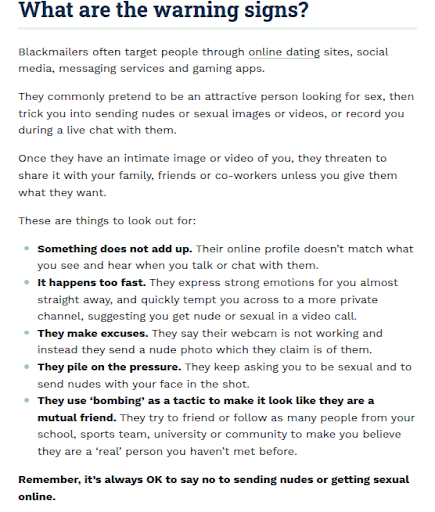
There are warning signs to look out for when it comes to accounts online. According to the eSafety Commissioner, their short article shows a small checklist of things to look out for that can save you from falling victim to a sexual exploiter online.
The unfortunate consequences of internet crimes
Many instances of sextortion have unfortunately ended in the loss of many teens. Teens that have fallen victim to sextortion often feel that there is no way out of their situation, many unfortunately resorting to suicide. In the US, reports of sextortion to the FBI have more than doubled in the past three years, reaching a high of 55,000 in 2024. The tragic deaths of many teens have opened up more cases and lawsuits against major companies. Meta, a global technology company that owns and operates major social media and communication platforms (Ex. Facebook, Instagram, Whatsapp), has been named specifically and brought to trial by grieving families who demand justice for their children.
Meta has expressed and promoted their platform’s safety and security for teen users. Meta Teen Accounts are specialized, default-on Instagram settings for users under 18, featuring built-in protections like private accounts, restricted messaging, and hidden sensitive content. While all sounding safe and secure, Meta reportedly failed to flag accounts that were being used for sextortion. Meta has also been accused of turning a blind-eye to user safety, while focusing on more engagement.
According to a Delaware superior court hearing (Families v. Meta), The company had been negligent in regards to the safety features the families were promised with their underage son’s accounts.
“The deaths of M.D.,-and-L.M., J.W., E.H., and B.B. were the foreseeable result of
Meta’s design decisions and repeated refusals to implement affordable, available, and identified safety features due to Meta’s prioritization of engagement over user safety.”
With Meta’s strong encouragement for user engagement, it often gave predators very quick and easy access to victims. Meta teen accounts promote safety for users under 18, but many of the features appear to be flawed. For example, the system seems to have little security with age verification, only asking for a birth date to confirm the user’s age. In hindsight, a predator could make an Instagram account, entering a fake birth year to pose as a younger user, and their follower recommendations would consist of people who are within a similar age group, even though the person behind the account isn’t actually the age they claim, nor the person. With this feature, it also gives them access to the victims’ followers.
“Meta further shared B.B’s friend information with this predator, which the predator then used to B.B’s stepfather, Luke, on Meta platforms to prove that he could.” (Delaware superior court)
Victims often fear that speaking up about sextortion will get them in trouble, but this is not the case. Many sources are available for victims, or someone who knows someone is being sexually extorted.
Sextortion is an unfortunate crime that can happen to anyone anywhere. It’s very important to look out for warning signs and signals that someone may not be who they say they are. If the signs to look for are made aware to more people, the instances could decrease and more people would remain safe online.