



























































“It’s okay to rely on other people and it’s okay to not always do everything by yourself and it doesn’t make you any less strong or capable,” said Rio Chaplinski after seeing “GOAT” opening weekend.
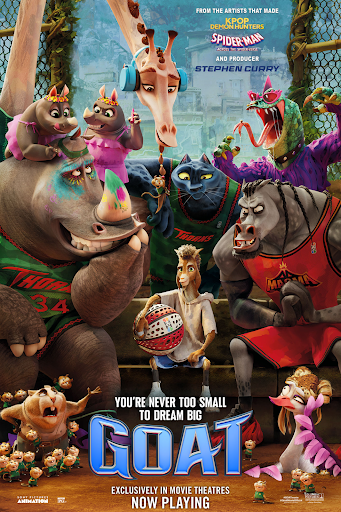
The new animated film “GOAT” directed by Tyree Dillihay, loosely based on the experience of Steph Curry’s rise to NBA stardom, has proven its worth to audiences and surpassed the highly anticipated film “Wuthering Heights” starring Jacob Elordi and Margot Robbie in the box office, despite its lack of franchise backing.
Outstanding performance in the box office
Skepticism circled the release of “GOAT” due to the lack of franchise backing in a market dominated by sequels and reboots. All who critiqued the release of the film were quickly silenced as audiences proved their love for the film through box office numbers.
Marley James of Young Hollywood said, “GOAT isn’t just holding its own. It’s showing that audiences will still show up for something new and unconnected to existing properties, especially when it’s animated and geared toward families,” which proves its ability to hold its own despite its franchise status. Audiences have shown the industry that they will show up for fresh concepts and families are seeking new animated content to enjoy together.
There was low projection for the turnout of the film and it was almost anticipated to fail as previous original animations have experienced such failure. To the shock of the industry, predictions of failure were overruled, ““Goat” is now at $58.1 million domestically, and has crossed nine figures total with $102 million worldwide. Its very respectable week-to-week decline of 36% — as opposed to a 57% drop by “Wuthering Heights” — suggests that the family-friendly movie could hang around in theaters for weeks and achieve profitability before it hits streaming,” said G. Allen Johnson of the San Francisco Chronicle. Not only was “GOAT” beloved by audiences, but its success was undeniably proven in the box office. It went from a film with many industrial doubts to surpassing the sales of one of the most highly anticipated movies of the year and evidently proving its longevity.
Audiences from not just the U.S. were able to recognize the impact of “GOAT” but this film was able to be acknowledged globally. Jamie Lang of Young Hollywood said “A basketball-driven, talking-animal animated feature featuring a globally recognizable NBA star has the potential to travel extremely well, particularly in China, where basketball fandom is massive and family-friendly animation remains a strong theatrical draw,” displaying that the global popularity of basketball and utilizing the story of an established NBA star to create a family friendly animated film has a strong draw in global markets.
Defying societal norms and displaying inclusivity
Although “GOAT” is an animated film geared towards children, many deeper messages and themes such as overcoming prejudice or adversity, eliminating self-doubt, working as a team are present in the film, which translates to a lot of real world scenarios.
“To the credit of the writers, roarball is a rather inclusive sport. There are no gendered teams, nor any discrimination based on species. Will might be the first “small” to make it big, but that stems from the public’s prejudice, not from rules that ban animals like him from playing,” says Carlos Agulier of The Los Angeles Times.
Including every gender and species in a famous sports league in a children’s film, teaches kids important lessons about the real world. Having children grow up watching films where, in this case, a female is the main role model of a man and there is a coed sports league allows more people to see themselves or their representation within films and helps the audience connect to the film more deeply. It can also help decrease the formation of prejudicial thoughts in children during their impressionable years.
“GOAT” itself is vaguely based on the underdog story of NBA superstar Steph Curry. Curry himself shared that “Obviously it’s about the power of a team too. No matter what walk of life, you can’t do anything great without the people around you. So it’s kind of cool to bring some of those storylines into GOAT and know how relatable it is, not just to my story but to everybody’s,” which shows how one person’s story can be relatable or influential to so many. This central idea in the film shows audiences that they shouldn’t allow their own walk of life to act as a barrier for their future. It proves that no matter where you come from an underdog can end up on top.
In the real world, many leagues or associations have regulations that could be exclusive to certain groups or individuals. William Bibbiani shared that ““Goat” actually does challenge multiple norms, as well as recent, regressive legislation, by arguing for absolute inclusivity. There are no weight classes in Roarball, no league for little animals, or even medium-sized animals like Will, and although no “smalls” have ever played professional Roarball before, there are no rules against it,” which shows that although society held certain prejudices, there was no set legislation or rules acting as barriers but more public standards showing that with enough hard work and dedication anyone can change unjust standards and make their dreams a reality.
The main character leading his team to success
“Will may be young, but he’s fully formed, righteous and principled, skilled and modest, a team player despite never working with a team before in his life,” says William Bibbiani of The Wrap.
Typically, a protagonist is meant to change and evolve throughout the story based on the people around them and instances they’re involved in. This story almost displays the complete opposite. Will knows his ideals from the start and sticks to them in order to achieve his roarball success. To achieve said success, he had to change the mindset and ideals of those around him instead of them changing him.
Will was able to impact the mindset of his teammates and change the way they thought about themselves, especially the character Jett Fillmore. Chaplinski shared that “she started doing things for the team and to help the team rather than just helping herself,” after Will had joined the team. Throughout the course of the film, Jett was able to open up more and become more secure with herself which inspired the team to take after their captain.
This whole film truly encapsulated what it means to bring people together through their own personal struggles to achieve a goal. Daniel Blackaby of The Collision said “While Willy’s own journey lacks adversity, in the spirit of sportsmanship, the film focuses more on the team than the individual. They must all overcome obstacles—pride, lack of confidence, lost sense of purpose, etc.—together to win the championship,” which explains that although Will himself required little development, the achievement of winning “the claw” depended on Will helping his teammates overcome their own internal struggles.
This film was able to fully prove its worth and importance to audiences across the globe, as well as displaying important messages and invoking deep thought within viewers of all ages.
It taught important lessons of bringing people together, overcoming prejudices, and not allowing societal barriers to hold you back from your full potential. Many instances the characters in this film had to face relate to the real world, and teaches audiences about how to create a more inclusive and cooperative future.